Workshop W-05: Stranded Hat with Steek

I can wear a hat or take it off,
but either way it’s a conversation piece.
[Hedda Hopper]

The whole point to this day-long class at the Maryland Sheep & Wool Festival is the steek. A steek is a seam allowance that bridges the gap of an opening in knitting. By bridging the gap, it allows the knitter to knit in the round making it easier to work some techniques like stranded knitting. The steek is cut and finished so that it won’t ravel and so that it will wear well.

I’ve finished steeks a number of ways over the years but prefer working two lines of slipped-stitch crochet before cutting up the middle of the steek. I’ll be showing the knitters in this class how to work the crochet with knitting needles. Although the class project is a doll-sized hat so we can make it in our limited time, I’ll also distribute patterns for a child-size hat shown here in red and white.

Workshop A-4: Non-Stop Heel

Success is not final,
failure is not fatal:
it is the courage to continue that counts.

[Winston Churchill]

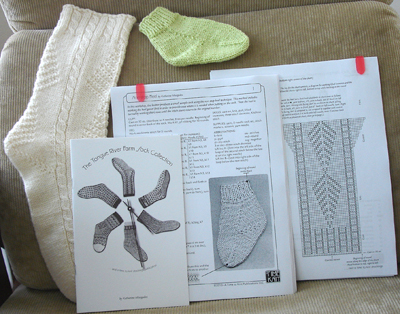
Rhythm is one part of knitting that I enjoy—it is meditational. Stopping interrupts the rhythm so, many years ago, I worked out a way to produce what I call a non-stop heel that I can continue to knit without stopping to create a flap, pick up stitches, etc. I work the gusset first then decrease the ease back out when I turn the heel. The patterns in my booklet,  The Tongue River Sock Collection all use this style heel.

Knitting a non-stop heel is another class I’m facilitating at the Maryland Sheep & Wool Festival. It is half a day (Saturday, 1:00-4:00 pm). I have a small project planned that gives the knitter detailed experience making a non-stop heel. I also will distribute a pattern for an adult sock that uses this heel treatment.

Workshop A-8: Replaceable or Peasant Heel

What breaks in a moment may take years to mend.
[Swedish Proverb]

Sock mending is almost a forgotten skill, but hand-knit socks deserve mending. The socks in the photo above have heels that can be raveled and re-knit if necessary. They are for another class I’m facilitating at the Maryland Sheep & Wool Festival. It is half a day (Sunday, 1:00-4:00 pm) so I have a small project planned that gives the knitter detailed experience making a replaceable or peasant heel. I have printed copies of the August sock (watermelon) from my CD book for each participant as well.

Workshop W-02: Gusset-heel Gansey Sock

The web of our life is of a mingled yarn,
good and ill together.

[William Shakespeare]

Look familiar? One of the classes I’m facilitating at the Maryland Sheep & Wool Festival lasts two days. We will produce the sock that is featured in the sock workshop on this blog. I recently knit another sock just to make sure we could actually finish one in the two-day class (Thursday and Friday, 9:00-4:00 pm.) All of the Gansey sweater features are included in this sock—a welt, mock seam, textured pattern and gusset. The handout includes the pattern. This LINK gives more information.

Maryland Sheep & Wool Festival

Modern invention has banished the spinning wheel,
and the same law of progress makes the woman of today
a different woman from her grandmother.

[Susan B. Anthony]

Maryland Sheep & Wool Festival

If I could speak to Susan B., I’d say, “Ms. Anthony, women have so gained confidence in their worth and effectiveness that they dredged out those banished spinning wheels, dusted them off, fixed them up and have taken to spinning again.” There is a big difference between having to do something out of dire necessity, and doing the same thing simply for the joy of it. I knit simply for the joy of it, and am blessed that I’ve been invited to share my knowledge with other knitters at the 37th Annual Maryland Sheep & Wool Festival (Saturday May 1 9:00 AM to 6:00 PM and Sunday 2, 9:00 AM to 5:00 PM, 2010). Here is a quote from their website:

The Maryland Sheep & Wool Festival is sponsored by the Maryland Sheep Breeders Association, Inc., a non-profit organization. The Festival’s purpose is to educate the public about sheep and wool. The Festival is organized and conducted by volunteers from the sheep breeding and fiber arts communities.

In the next few posts, I plan to show photos from the workshop projects I’ve prepared for my classes:

  • A-4: Non-Stop Heel
  • A-8: Replaceable or Peasant Heel
  • W-02: Gusset-heel Gansey Sock
  • W-05: Child-sized Stranded Hat with Steek

Hot Cross Buns and other temporary joys

Hot cross buns,
Hot cross buns,
one ha’ penny,
two ha’ penny,
hot cross buns.

Some things are better for being temporary. Warm weather came to northern Indiana yesterday and I, as I pushed my convertible top into the trunk of my roadster, rationalized that a warm day with budding crocus seemed even sweeter when contrasted with the ice and snow that has recently melted. Those are the kind of thoughts some folks have when they can’t overcome inertia and move to a more temperate clime.

I headed to the dentist with an ache in my jaw. After an x-ray, he ordered Penicillin and scheduled me for gum surgery late next week. That was the bad news. The good news is that there is a store nearby that fills antibiotic prescriptions for free. Sun warmed my face and wind tangled my hair as I drove there. However temporary my lower teeth might be, I was determined to do what it takes to enjoy them for as long as possible.

While waiting for the pharmacy to fill the prescription, I browsed the grocery department and there they were—hot cross buns. How could I forget their heirloom taste of currents, raisins and spices? How could I pass up the chance to enjoy them for the fleeting amount of time they appear each year? They are like the budding crocus. They are here temporarily and that makes them even better—kind of like life. As Gleason said, “How sweet it is.”

(The new masthead image is from photographer, James E. Miller, Willowgreen.)

Photoshop vs. Fireworks

To know the true reality of yourself,
you must be aware not only of your conscious thoughts,
but also of your unconscious prejudices, bias and habits.

My Adobe CS4 came bundled with not only Photoshop but also Fireworks. Why? I asked myself. I’ve used Photoshop since version 1.0 and could see no reason to learn a new piece of software. No reason except for one—I recognize that I tend to be biased by familiarity, and I need to make a conscience effort to try other things to keep from missing something really cool.

Making use of my Lynda.com membership, I started viewing one of the set of Fireworks tutorials (Rapid Prototyping) and it blew me away. Over the years, I’ve cobbled together my own method of producing comps for website development using Illustrator and Photoshop. I will still use Illustrator for my illustration work and Photoshop for photo editing and print production, BUT I’m going to give Fireworks a try on my next web job. I can tell from the tutorial that I’m going to love it.

That brings me to today’s hint from the woman with the white hair:

Being aware of bias in your thinking could be your greatest asset in personal growth. Use it as a flag, a sign post. Let it motivate you to research the other side and see if there is any validity to your biased inclination.

Olympic Sweaters

Most other competitions are individual achievements,
but the Olympic Games is something that belongs to everybody.

[Scott Hamilton]

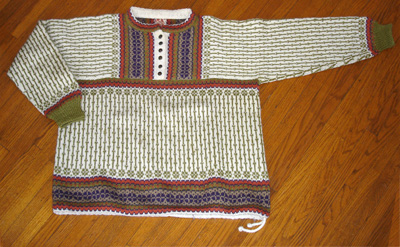
The Winter Olympics fascinate me on several levels even though sports aren’t a particular interest of mine. One level includes ski sweaters. I knit several Dale of Norway (the company who designs ski team sweaters) ski sweater patterns over the years then, during one Winter Olympics, I knit a design of my own—the sweater in the photo (closeup in the new masthead).

This seamless sweater starts with a yoke that also forms the sleeves. There is a buttoned placket and narrow, stand up collar. I picked up the body stitches between the sleeves of the yoke, and knit down to the lower edge. The bottom is finished with a hem that contains a draw string. The yarn is a DK weight wool/mohair blend.

Collaboration and love

In the long history of humankind (and animal kind, too)
those who learned to collaborate and improvise most effectively
have prevailed.

[Charles Darwin]

My two grandmothers (Katherine and Gertrude) were friends. During the 1930s, they quilted together weekly at the same little Methodist church in Peru, Kansas. Katherine had the reputation of being the finest needle woman in the county.

In her later years, Katherine’s mind drifted away, and her weekly quilting skills became less and less adept. Afraid that people would start to notice Katherine’s decline, Gertrude stayed after the quilting bee each week, picked out her friend’s stitches and resewed that portion.

I cherish the quilts that are products of my grandmothers’ loving collaboration. It wasn’t until I was older myself that I studied the quilt and said to mama, “From the style of stitches, I’d say this looks like it was quilted by mostly one person.” That’s when mama told me about Gertrude’s lone, loving quilting sessions. For me, that makes this a true friendship quilt.

I was inspired to write about collaboration after reading Janet Riehl’s interviews on Riehl Life.

Story Circle Network Conference

Thousands of candles can be lit from a single candle,
and the life of the candle will not be shortened.
Happiness never decreases by being shared.

[Buddha]

From last Friday through Sunday, my gratitude built with each passing experience. Starting with pre-conference activities like coaching sessions and the afternoon as a volunteer in the vender room, I grew in knowledge, confidence and fullness of heart. Friday evening’s keynote speech by Heather Summerhayes Cariou (Sixtyfive Roses) inspired us all as she recounted her memoir-writing experiences, and encouraged us to tell our own stories. Saturday and Sunday were filled with educational sessions, luncheons, open mike night and a closing address by Mary Gordon Spence (Finding Magic in the Mundane). After it was over, those of us who stayed to fly home on Monday met for supper and an effervescent discussion of our experiences.

Speaking of the mundane, while I was shoveling snow this morning, I decided I needed to fill my larder in case I get seriously snowed in so I headed to the grocery about 6:30 a.m. Mary Gordon’s speech came back to me as I browsed the produce. I doubt that I’ll ever shop for groceries again without thinking of her story about making a list according to letters in the alphabet. I’ll also never sit down to write without remembering those magical few days in Austin. Thank you Susan, Peggy, and all you other inspiring women who each now own a piece of my heart.