Toe: A part of the foot used to find furniture in the dark.
[Author Unknown]
NOTE on May 18th, 2009: This and the following two posts were published in January, 2008, then I got stuck describing how to work the heel. Now I have it figured out and changed it completely from the original. I knit a peasant or replaceable heel as follows:
- I knit scrap yarn across half the sock.
- Then, using the sock yarn, I went on knitting the sock leg and cuff including a cable pattern on each side of the leg (called a clock).
- After binding off the cuff, I removed the scrap yarn, and picked up the stitches on 4 sock needles.
- I knit a heel in the round, decreasing on each side every other round
- When 20 sts were left, I bound off using the Kitchner stitch.
For the toe, the increasing starts after one plain round. There are 4 increases per round (two on the right side of the foot and two on the left side of the foot). The increases are worked every other round. The first photo below shows the toe after first set of increases are worked, and the increases on the finished sock. The second photo shows the toe when all of the increases have been worked. I worked the increases as follows:
 • k1, m1+k1, k6, k1+m1, k2, m1+k1, k6, k1+m1, k1
• k 24 around
• k1, m1+k1, k8, k1+m1, k2, m1+k1, k8, k1+m1, k1
• k 28 around
• k1, m1+k1, k10, k1+m1, k2, m1+k1, k10, k1+m1, k1
• k 32 around
• k1, m1+k1, k12, k1+m1, k2, m1+k1, k12, k1+m1, k1
• k 36 around
• k1, m1+k1, k14, k1+m1, k2, m1+k1, k14, k1+m1, k1
• k 40 around
• k1, m1+k1, k16, k1+m1, k2, m1+k1, k16, k1+m1, k1
• k 44 around
• k1, m1+k1, k18, k1+m1, k2, m1+k1, k18, k1+m1, k1
• k 48 around
• k1, m1+k1, k20, k1+m1, k2, m1+k1, k20, k1+m1, k1
• k 52 around
• k1, m1+k1, k22, k1+m1, k2, m1+k1, k22, k1+m1, k1
• k 56 around
Since this is sport weight yarn and I used US #2 needles, I only need 56 stitches around for the foot and the leg. I used what I call “lifted increases.” This LINK will take you to a page that shows a diagram for this kind of increase (look at the end of the page). m1+k1 is a left-leaning increase and k1+m1 is a right-leaning increase. You are welcome to use any increase you prefer.
The foot is knit around and around on the 56 stitches per round. You can try it on to see how long a foot you need to knit before starting the heel. I’ll show the heel turn as soon as I get the foot knit.


 The poem is from World War I, but the tintype is of Sammy Marvel, 1842–1864. He died in the battle of Atlanta on his twenty-second birthday. He was my great-great uncle.

 STEP 1 — Put a slip-knot stitch on the needle. This will not be used in the actual stitch count and will be dropped later.
 STEP 2 — Cast on 10 stitches using the half-hitch cast-on technique. You will have 11 stitches on the needle counting the slip-knot stitch.
 STEP 3 — Knit across the 10 cast-on stitches. Slide the slip-knot stitch onto the needle.
 STEP 4 — Turn knitting upside down so you can knit back in the backs of the half-hitch cast on stitches. Start with the thread that connects the slip-knot stitch to the half-hitch cast on stitch. Use another needle to lift the strand under which you will knit. The photo shows the row half knit.
 STEP 5 — You will have 10 stitches along the edge you just knit. When you have added more rounds, you will notice that this method produces a seamless effect. I think it might be magic.





 The photo at the left puts the hat and mitten photo into perspective. Elizabeth is an eighteen-inch Magic Attic doll. Her outfit is knit using Shetland jumper-weight wool and size #1 or #2 needles. The Knickerbocker pants have tiny buttons at the knees. The long socks have lace clocks on the sides. The vest border was knit using mitered corners and a stitch pattern. I built a long opening in the back of the pull-over sweater so that I can dress her without pulling her clothes over her head.


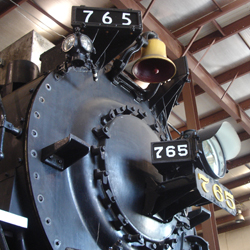 Water, coal,
 The mail just came and I received a copy of
 Knitting, writing and other joys